


Katy: Michelle and Nicole, thank you so much for being here. I have so much that I want to ask you and talk about. I’m going to kick us off here. Michelle, you run an eating disorder treatment center in Hawaii, and I would love to know: how do you see the difference between diet culture, disordered eating, and eating disorders? How are they connected? What’s your take?
Michelle Villanti: Well, I think any behavior is on a continuum. Anything that ends up leading to an eating disorder most probably starts with a diet mentality, or embracing some things that the culture is telling you about your body, about how if you look a certain way or you are a certain size, it means something. Depending on each individual’s innate vulnerability or their history, they’re going to be more susceptible to the progression continuing. You would go from maybe having some disordered eating to progressing into an eating disorder, and it depends on what I call different markers that lead to the development of an eating disorder, which would be a whole other podcast.
Katy: And I think that’s what’s important for people to understand: it is all a continuum. Whether you’re listening to this and you have an eating disorder, or you used to have one, or you just exist in diet culture like we all do, the conversation is relevant because of that continuum.
Michelle Villanti: We run a treatment program that specializes in eating disorders, among other things, and what we address is the underlying issues, what’s driving any particular problematic behavior. If I don’t address what’s driving it, then it will never go away. There’s a reason why someone might use an eating disorder or drugs or alcohol or gambling or overworking. Anything can be a thing, is what I always say, and it’s serving some kind of purpose. If we don’t get to what’s driving it, sometimes people will stop one addiction and switch to another. That’s very common. If I don’t address what’s underneath, then what’s the next thing I’m going to replace it with?
Katy: Yeah, I see that all the time as well. What would you say are some of the most common things that are underneath? What are some of those drivers that you see over and over again?
Michelle Villanti: I think it really comes down to trauma. They talk about big-T trauma and little-T trauma, but what I’ve seen in all the years that I’ve been treating trauma and eating disorders is that sometimes it’s the little-T trauma that creates the most entrenchment, because it’s not in your face. If somebody grew up in a home where there was domestic violence, alcoholism, the children were being abused, there was sexual abuse, it’s right in your face. Whereas with the more subtle kind, when I’m talking to clients, I’m talking to them about narcissistic abuse.
There are some bad parents who do want to abuse their children, but most people who pass on some form of trauma to their children have their own unmet narcissistic needs that they end up getting met through the children. Even in small ways: a parent that uses a child as their confidant, or a parent that is over-empowering the child and thinks the child can do no wrong, so the child becomes the golden child. Or the child that gets scapegoated because they’re not as smart as their brother. There are so many subtle ways that people can be traumatized. I call a lot of us in the world the walking wounded. We’re walking around with unhealed wounds that, if we just gave them attention and time and compassion for the fact that they exist, we would be able to heal.
Trauma isn’t something that you do to yourself. Trauma is a normal response to an abnormal event. That’s how I define trauma. Anything that the child perceives as threatening or unsafe will land in their body as a form of trauma.
Katy: That makes so much sense. And like you were saying earlier, people cope with that in different ways.
Michelle Villanti: Absolutely. It’s pick your poison, or pick your protector, because all of these things that we do to cope are protecting us from what’s underneath, the wounds and the hurt.
Katy: I love that reframe, viewing it as your protector so you can appreciate the function it’s been there for. It’s just not serving you very well at a certain point.
Michelle Villanti: Right. Every part of yourself has good intentions. It’s trying to help you in some way. And whatever you established as a child as a protector tends not to function all that well in adulthood. But it was absolutely essential in childhood for survival a lot of the time.
Katy: Nicole, I’m curious for you as a nutritionist: what are the trends from your vantage point that you’re seeing in our culture that are leading people down that path of disordered eating, or that make it hard for us to have a healthy relationship with food?
Nicole Coleman: That’s a great question. I would say comparison is a big, big, big thing to talk about. A lot of us are stuck in this mental space of constantly comparing and body checking. It’s hard not to when we’re doing that face-to-face, whether it’s at school, at work, with our own family members, at a coffee shop. Then we have no space to process that, because we get on our phones and we’re doing the same thing online. It’s just this constant spiral of comparing, body checking, not feeling great about ourselves.
Technology is definitely a blessing and a curse when it comes to this stuff. I think it’s really wise to have a little bit of censorship in regards to social media and who we follow. What’s become really popular the last couple of years is influencers on social media posting “what I eat in a day” or “this is my exercise routine.” Although from the outside looking in it might not seem harmful, it actually kind of is. When it comes to parents and children, I think it’s important to have a little bit of censorship with the media and to have open conversations: hey, this routine might work for somebody, but it’s not going to be sustainable for a lot of other people. We live in constant chaos of entertainment and media, and we just don’t get a break from that comparison at all. And then all the fads happening on top of that.
Katy: Always. There’s constantly a new one, right? Both of you have talked about your own lived experience recovering from an eating disorder and body image struggles. If you catch yourself comparing, or you have a bad body image day, what do you do with that? Or does that not really happen to you anymore because of the work that you’ve done? Tell us more about your own personal process with this.
Michelle Villanti: I’m older, I’m in my 60s. I had an eating disorder starting around age 11, and this was in the 70s. There was no treatment for eating disorders in the 1970s. Nobody knew what PTSD was. The Vietnam vets were coming back with horrible PTSD. I had PTSD. Nobody knew what it was. There was just no help for it. I was also in a ballet company, so I was really inundated with pressure, which is a big topic for me. I talk a lot about it with my clients. There’s the kind of pressure where we are inspired and internally motivated, versus the pressure from the outside world, and that basically reinforces this idea of “suck it up, just do it, get over yourself, pull yourself up by your bootstraps, rugged individualism.” For highly sensitive people, which a lot of people are, that pressure is deadly.
It was such a process for me to get healthy and strong and clear my eating disorder, and it was like making it up as I went along, because there was just nothing out there. I really didn’t want anyone to have to go through what I went through to get recovery, to be free of the eating disorder, and to heal the trauma.
You asked if I still struggle with body image, and the answer is absolutely not. As an adolescent, I was raised to think for herself, so I was kind of a rebel. One of the ways that I work with clients, as well as from my own lived experience, is that I question everyone. I question my own thinking even. There’s the book The Four Agreements, and there’s actually a fifth agreement, which is basically to be skeptical of everything. “Skeptical” is kind of a rough word. Be willing to be curious about what you think, because just because you think something doesn’t mean it’s true. I have this part of me that puts her hands on her hips and says, “You’re not the boss of me. Where did you get this? Why do you believe this?” My mom, who was born in 1916, used to say, “Michelle, if everybody jumped off a cliff, would you jump off a cliff?” I looked at her like, “No, hell no.” And she goes, “Well, then why are you listening to what other people think about stuff?”
Katy: That’s great. And it’s so encouraging to hear that you can get to that point where that’s not something that plagues you anymore.
Michelle Villanti: It’s not. It’s working towards having that grounded peace, contentment, being integrated. They talk about empowerment, but I would say also just being able to be humble. I’m a person, you’re a person.
It’s either everybody matters or no one matters, therefore everyone matters, and nobody’s better than anyone else. I always tell my clients, you’re special, but you’re no more special than anyone else. When we’re in that comparison thing, it’s “compare and despair.” I’m comparing myself because I think you’re better than me, or I think I’m better than you. That’s a hard part of self-judgment and judgment of others to be carrying around with you.
Katy: Absolutely. Nicole, what about you? What’s your own experience with body image, and how do you navigate that?
Nicole Coleman: My upbringing was a little different. Same, same but different. Definitely the perfectionist mentality: let’s be perfect, let’s smile, let’s stay small, in all things, mentally, physically, emotionally, spiritually. I came from a very health-influenced background. My family has been in the health food scene since 2005. Exercise, exercise, we’re going to follow all these diet trends. I think when parents do that, they are coming from a good place. It’s not coming from a malicious place. They think they’re doing the best for the family.
But then you get older and you realize: am I experiencing joy? Where’s the joy in my life? Is anything being taken away from me? And what am I hyper-fixating on? My hyper-fixations were: let me work out twice a day, because I’ve been told that I’m ADHD and I’m too much, so let me focus on this. Let me eat super healthy. And I’m sitting at a table with friends at a restaurant eyeing the appetizers, and in my head I’m having intrusive thoughts about eating too much or eating too little. You start to see this pattern that develops over time, and it robs you of your own experience of being able to experience joy with people and with yourself.
So it took many years of creating my own toolbox of resources for myself, and getting to a point where I have something that I look forward to every single week of my life. We all need something to do, someone to love, and something to look forward to. If things in your life are taking away from your own experience and not allowing you to feel that joy, then there is something to dig deep with and figure out for yourself.
A lot of the time with young women, and young men too, it is this body checking, comparison, disordered eating pattern that we get into, because none of us grow up having relationships with food on our plate. In this economy, most of our parents growing up both worked full time. The norm was eating breakfast on the way to school. We’re not taking a moment to say a prayer before our meal or check in with our hunger and fullness cues. We are rushing and eating cereal in the car, and then we have a 20-minute break. These patterns develop over time, and then we become adults and realize, well, what kind of relationship do we have with ourselves and with food? And why are we comparing ourselves with other people’s bodies and foods? I think it’s an interesting trend to take videos of yourself every day and share it online with people. Like I said, I don’t think it’s malicious at all. I don’t think people understand that this might be harming and affecting some people.
Katy: I love what you said about having something to do, someone to love, something to look forward to. What was the third thing?
Nicole Coleman: A rabbi once told me this when I was 12 years old, and I didn’t really understand it at the time, but I tell everyone this now. We all need something to do, someone to love, and something to look forward to. If we have those three things in our life, man, are we going to succeed and be happy. I think about that every week: okay, what are my three things? It doesn’t have to be a romantic partnership. It could be a friend, a family member, any loved one. A dog. Something to do is maybe your work, or maybe you don’t have a passionate job, and that’s okay. What are your hobbies? What is your one thing to do that brings you joy? And then the last thing, something to look forward to at the end of the week, that extra little kick.
Michelle Villanti: I think those three things are great, except that they’re missing the being piece. I’m so anti-doing, because most of us are human doings instead of human beings. We’re defining ourselves based on what we do. Presence is one of the process parameters. If I’m present with myself, why am I thinking about what I have to look forward to? What about what’s happening right now? Can I experience joy and peace in this moment, or am I postponing it for a particular event that I think is going to provide it for me? See what I mean about how I challenge things and question everything? This is useful for people, it’s concrete, but it’s surface. It doesn’t get to the underneath stuff, because it still goes along with the culture of doing versus the culture of being.
Katy: We might have to record a whole other episode just about that. I love how you’re willing to challenge the status quo and say, “No, what if we go deeper with this, and why do we even need to be thinking about that? Why can’t we just be right now?” That’s such a profound thing to think about.
So you alluded to this, and it’s a good segue. At Nova Luna, you have something called process parameters. At a very high level, what are they and why do they exist? Then we’ll talk about what they are.
Michelle Villanti: When people are doing trauma work, when they’re doing things that are very difficult, they need a container, and they also need guidelines. I use the word “parameters” because I hate the word “rules.” Parameters to me feel like I’m holding you. A child needs structure and routine and rhythm, as do all of us. The parameters are something that holds us and guides us, kind of like a good parent would.
Katy: That makes total sense. The very first parameter is priorities. Why did you put that one first? What does that mean to you?
Michelle Villanti: If you don’t prioritize yourself, or prioritize whatever is in front of you, then where do you go from there? It’s calling out what’s important to me. What is so important that I am going to be with it to start with? If I don’t prioritize anything, I’m probably going to be hither and yon, very scattered. So prioritize yourself, prioritize your treatment, because if you don’t prioritize yourself, nobody else is going to. Truly. It’s: I matter. I am my own priority, and my healing, my well-being, is something that I’m going to prioritize. All of this is because I matter.
Katy: What a great way to set the scene and set the tone. The second one is punctuality. How do you think about that?
Michelle Villanti: I’m from the East Coast. If you didn’t show up on time, you were disrespectful, you were rude, and basically it was shameful to make an agreement to meet somebody or do something at a certain time and not show up. There were consequences when I grew up: you could get fired, people wouldn’t want to be your friend. So punctuality to me is that you show up on time because you’re showing up for yourself. If you’re really important and you’re really prioritizing yourself, why wouldn’t you show up when you say you’re going to show up? Which leads to the third parameter, which is promises. If you say you’re going to be somewhere, it’s because you’ve made a promise, so it’s being able to keep your word to yourself first, and then to whoever it is that you have made an agreement or a promise to.
Katy: Here’s a question, getting into the mind of some of my clients who have eating disorders, or even just people who’ve done a lot of dieting. It’s “I promised myself I wasn’t going to eat chocolate or sugar or whatever.” They’ve promised themselves basically that they were going to restrict or exercise. How would you work with a client who is approaching their promises to themselves in that way?
Michelle Villanti: To me, that’s more of a rule rather than a promise. That’s how I would differentiate. You can say you promised yourself, but this sounds like a cage to me. It sounds like you’re boxing yourself in, and it’s very rigid. It sounds like a form of entrapment. You promised that you would only eat this and that’s it. But what if you don’t want to just eat a salad every day? What if you wanted a brownie?
And then I would go beyond it. This rigidity is a form of perfectionism, and it sounds like you don’t feel safe and you don’t trust yourself, so you’ve got to have these rigid rules. Let’s look a little deeper at that. Where did that come from? Why is there this need to be so in control? That’s a big thing for people with eating disorders: control. This is where meeting them where they’re at comes in. I get that you really believe you need to do this and that this keeps you safe, but let’s look at where it came from, that you don’t feel safe. Let’s get curious.
Katy: And trusting yourself instead of needing rules. It makes me think about all the different biohacking devices people are using that give them all these numbers. Wearing the ring to tell you your sleep score: can’t you just ask yourself if you’re tired, if you feel like you got good sleep? Why do you need a thing to quantify it for you?
Michelle Villanti: To me, that feels like fear, just abject fear, and the fear came from somewhere. We use Internal Family Systems here. Basically, this part came into existence for a really good reason. There’s a reason these behaviors are happening, and these behaviors are trying to protect you and keep you safe. I get that. And let’s also look at where it’s confining you and controlling you.
Katy: Like that prison kind of thing you were talking about.
Michelle Villanti: Yes, a cage.
Katy: The next process parameter is privilege. What does that mean to you guys?
Michelle Villanti: At Nova Luna, it’s a privilege being here. But bigger than that, and I just thought of this at the moment, it’s a privilege to be here in this life, to be able to live, to breathe, to see, to hear. In being here, you have access to resources and guidance. At Nova Luna you’d have access to a team of people who are here to help you, and you’re not alone. We have the privilege of not being an island. We have a good mind, we have a heart, we can access the things around us and learn.
When people talk about gratitude lists, I’m just like, what about the fact that you can breathe? Have you ever had a cold and you can’t breathe? The fact that you can wake up every day and you can breathe and see and hear, isn’t that huge? What would your life be like if you couldn’t do any of those things, if you couldn’t walk or move your arms? That’s where I go: it’s a privilege to just be and exist. I did not put that in the process parameters as I wrote them up, because it was pertaining to the treatment center, but on a larger level, that’s what I think about.
Katy: On a broader scale, and cultivating that gratitude. Number five is permission. What does that one mean?
Michelle Villanti: On a regular basis, growing up in the culture that we’re in, I’m just going to speak of women, but men have their own set of rules they’re supposed to follow, a lot of times people feel like they need permission to exist, permission to do whatever. One of the most important things you need to give yourself permission for, particularly in this culture, is the permission to receive. People who have eating disorders are really comfortable giving, because then they’re in control. But when you’re in a state of receptivity, then you are vulnerable. When you were a child, you were vulnerable, and you were supposed to be able to receive and grow and get all those things you needed to be nurtured and grow up to be a healthy human being. So you’re giving yourself permission to receive help. You’re giving yourself permission to not have all the answers, to be vulnerable, to take up space, to avail yourself of support. Somebody could be brilliant and give you all of the wisdom in the world, but if you did not give yourself permission to receive it, it’s like whipped cream on garbage. That’s a term I use a lot.
Katy: Love that, whipped cream on garbage. Nicole, as a dietitian, I often think a lot about permission with food. It’s so sad that we’ve gotten to the point where people feel like they need permission to let themselves eat when they are hungry, or choose what is actually satisfying to them. How do you talk with clients about that?
Nicole Coleman: A lot of people don’t even have that conversation with themselves. When people first come to treatment, whether it’s disordered eating or an eating disorder, I think a lot of them get very frustrated when I tell them, “Well, you should give yourself permission to eat a donut in the afternoon if that’s what you’re craving. Honor that craving and let’s talk about it. Let’s process that and see where that’s going.” We always talk about the eight types of hunger here. Is your heart hungry? Are your eyes hungry? Is your mouth hungry? Is your stomach hungry? We go over all of those things, which is a whole other podcast. But I think we have to really dig deep with the permission stuff, because you don’t need anyone’s permission to eat what you want. And there’s a difference between eating healthy and sustainably, but even the word “healthy,” what does healthy mean to you? In a perfect world, everyone would be able to eat whatever they wanted and have a sustainable diet.
Katy: You know what’s interesting? A lot of times the response I get from people about this is basically, “Well, if I gave myself permission, I would just eat nothing but donuts all day, every day.” There’s so much fear and distrust of themselves wrapped up in it.
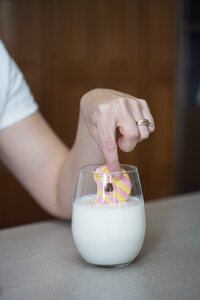
Nicole Coleman: And then I’ll say, “Okay, let’s do that for two weeks. Eat a donut every day for two weeks. You’re not going to want a donut ever again.” You’re not going to want to eat multiple donuts a day, every single day, for more than two weeks. I promise. You’re going to want variety, and that’s joy, thinking about food variety and all the things you get to try and experience. In intuitive eating, it’s called unconditional permission.
Michelle Villanti: When we think about giving ourselves permission in the food realm, it’s a survival thing. We need food to actually live, and yet we’ve turned it into this power struggle, where you have to earn it. It’s not something you do because it’s what keeps you alive.
The other thing we work on is listening, listening to your body. If you have all of these parts that are talking to you, all these critical things that are running you, you wouldn’t be able to know what it is that you want. When people finally get to a place where they’re trusting and listening to their body, it’s amazing. The people I work with who have recovered from an eating disorder basically have this freedom with themselves around everything. They say, “I’m going to listen to myself. I may have an eye hunger or a heart hunger, but I’m so full that if I ate that, I would feel sick. And I love myself, and I’m not going to make myself sick.” My mother, who didn’t have an eating disorder and had a very healthy relationship with food, would say, “I’m taking that stuff home in a doggy bag so I can have dessert, because I love dessert.” She wouldn’t want to be overfull. Or: do I want dessert, or do I want a hug from a friend? What am I actually craving right now?
Katy: Being able to connect with what you’re hungry for, literally or metaphorically.
Michelle Villanti: There’s a whole idea that when people crave certain things and they’re not hungry, they’ve entered the world of metaphor. If I’m not hungry and I want chocolate, I might actually be hungering for love, affection, sex, whatever. The different types of food you may be craving when you’re not hungry indicate an emotional hunger.
Katy: I love looking at the symbolism. Back to our process parameters: number six is perseverance. Tell us about that one.
Michelle Villanti: It’s refusing to give up on yourself. I always tell people, 95% of achieving anything is just showing up. I talk to people about their “I don’t want to” parts, and I always say, I get it, I have “I don’t want to” parts too. One of my favorite affirmations is “I can do hard things.”
I had an experience a number of years ago, when I was far less evolved. I asked someone, “I want you to go to the bank for me today.” And he said, “You can want me to go to the bank, but I’m not going.” That was such a learning lesson for me. I can want something or not want something. I can not want to do something, and that’s okay. In that moment maybe I don’t do it, but then I come back. That’s followed by the patience piece: I’m going to keep showing up. But sometimes I don’t want to, and if I don’t show up in a particular moment, it’s okay. I can honor the “I don’t want to” part, but if I let a two-year-old part drive the bus, it’s going over the frickin’ cliff. I’m not going to put the two-year-old in the driver’s seat. But you can give yourself that grace. And if I’m struggling in that way, I might say, “I can do hard things,” but also, if I don’t want to, maybe it’s because my body is saying enough already. I’m exhausted, I need to eat. You know the HALT check: am I hungry, angry, anxious, lonely, or tired? If I’m any of those things, before I do anything I’m going to take care of myself in those regards.
Katy: That’s great. There’s so much wisdom that comes out of talking about all of these. Number six was perseverance, seven was patience, and number eight is practice.
Michelle Villanti: Practice is like anything: anything that we do over and over again, we usually get better at. We got some of the complexes and behaviors that we have because we did them over and over again. Before we can practice something new, a lot of times we have to let go of something that’s not working for us. So sometimes it’s unlearning, and then we have to learn something new. If it’s something new, we’re going to have to do it more than once, over and over and over again. Practice gets us to where it’s integrated. Now we don’t even have to think about it anymore, because we’ve practiced it to the point where it’s just part of who we are. Like an incredible pianist, they’ve practiced so much.
Katy: It makes me think of getting in the car, where you practice to the point that you just hop in and go. It’s not such a conscious, step-by-step effort.
Michelle Villanti: Imagine if you had to think about everything, like when you were learning how to drive.
Katy: Where’s the turn signal? Where are the windshield wipers? Okay, and number nine is play.
Michelle Villanti: All work and no play makes Jack a dull boy. Playing is creation. It’s how we reconnect with our curiosity, our creativity, joy, spontaneity, pleasure without needing everything to have a purpose, which is huge. I try to make recovery fun. At Halloween, it’s been a few years, but we used to bob for apples. We’d hang donuts on a string and people would do the donut game, whoever eats the donut first. It’s incorporating play and joy, because this work is so hard that we’ve got to allow play. It ties everything together. When we get out of our head and we’re just into our creative selves, that’s when the inspiration comes in, when the ideas come in. When we stop overthinking and we just start being with what we’re doing in that moment, which brings us to the last process parameter, presence.
Katy: Do you have certain ways that you help people cultivate presence with themselves or with the moment?
Michelle Villanti: Sometimes we do mindfulness things: what are you hearing, what are you seeing, what are you smelling, what are you feeling? Helping them to get out of their head and be in their body. Presence sometimes is having people go outside and just sit under a tree. It’s unusual, the people who actually stay and do treatment for years and recover. If I tell them to go commune with a tree, they will. Go see what a blade of grass might have to say. Notice the breeze against your face when you go outside. Feel the ground underneath you. What does it feel like to just think of nothing but allowing yourself to breathe? Some people will meditate. We’ve had yoga in the program, and we’ve taught some meditation. A lot of times people have trouble with meditation because they get frustrated that they’re very focused on doing it right. So that’s for later on if that’s something they choose to do. When somebody’s spun out all the time, I also don’t want to risk people going into what I call spiritual bypassing, like “oh, rise above it.” That’s just more rules, as far as I’m concerned. There’s the right way to do spirituality or the right way to be mindful. It’s just more rules.
Katy: Absolutely. I was thinking about what you were saying, Nicole, about how quickly we grab our phone. We might go from one in-person interaction to boom, we’re on our phone. It’s so hard to be present in this day and age. We’re constantly thinking about what do I need to do next, or what do I have going on later. A lot of people feel that pull in all these different directions, or they’re just zoned out with their phone 24/7.
Michelle Villanti: We have people who are addicted to their phone, and some of it is a form of self-soothing. I’m from a different generation. I think phones are stupid. I think the whole social media stuff is stupid. It’s doom scrolling. You’re part of the empire if you want to do this, give up your autonomy and your freedom and listen to what other people have to say instead of yourself. There’s been all this research about what scrolling does to the brain and how it affects attention. It’s serving some purposes, but I think by design it’s also giving people a new addiction and a new way to distract themselves from actually being present. Be awake. Open your eyes. Notice what’s going on.
Information and education is power. When we learn, we change, which actually leads to the last two process parameters that aren’t even written down. First, it’s really important not to listen to the over-culture. “Over-culture” is a term Clarissa Pinkola Estés, who wrote Women Who Run with the Wolves, used. That’s not a word I created. Give credit where credit’s due. When I first heard Nicole talk about people sharing what they eat in a day, my first response was, “Who the f— cares what they’re eating? How boring.” I’m thinking the person who did the video, get a life. Clearly you have nothing else to do if you think this is content other people would give a rat’s ass about. Just saying.
Katy: So funny. It does remind me of a video I saw the other day. A young woman who’s recovering from an eating disorder sat her grandma down next to her and told her the things her eating disorder says to her, the rules. And her grandma’s like, “Who told you that?” And she’s like, “Me, my own head.” And her grandma says, “That’s the dumbest thing I ever heard.”
Michelle Villanti: That’s kind of me, but I’m a grandma.
Katy: For context for everyone listening: right before we started recording, Michelle was telling me, “I’ve got these 10 process parameters, but then I just thought of two new ones.” So this is hot off the press. You’re hearing it here first. Tell us about these new ones, because I think they’re especially powerful.
Michelle Villanti: The 11th is perception, because by the time you’re done going through these 10, your perception of yourself is going to change. Your intrinsic self is going to have transformed. Perception is how we see things, so we get to choose how we see ourselves and how we see the world. You’re entitled to see things the way you see them, and I’m going to see things the way I see them, because that’s who I am.
The other thing about perception, which leads into purpose, is that when we take in information, initially it’s called assimilation. We’re just taking in information, and that doesn’t change us intrinsically. It’s just information. But accommodation is how we integrate it: this is how I take this information, this is how I see it, this is how I come to see myself. It’s not just assimilating the information but accommodating it to who I am. Then I have the lived experience of what I have learned and how it has changed who I am and how I’m going to live in the world. Accommodation is more like integration: now I’ve integrated this, this is who I am now.
And then finally, purpose, which I hate that word, by the way. Purpose is: what am I called to? So many of my clients come in and go, “I don’t have a purpose. I don’t know who I am. I don’t know what I want.” And it’s like, yeah, you’re not going to get there until you unpack all of these parts, and they’re burdened, and heal them, and all those other things that are necessary. With purpose, it’s: what am I called to? What is calling me? And I’m also calling it. It’s a relationship. People who are spiritual or believe in God might say, “I’m aligning my will with God’s will.” It’s a call: what is it in my soul or in my spirit that I couldn’t not do? I am called to this.
Interestingly, which I mentioned before we got on here, it’s the first step of the hero’s journey, which is the call. It brings up a lot of other deeper questions. Who’s calling me? Is this love? Is this God? Is this something greater than myself? But whatever is calling us, we are calling it to us. That’s just something I know. I might be wrong, but that’s how I see it. In the hero’s journey, first it’s the call, and then it’s the refusal of the call. Okay, I want to refuse the call, no thanks, I don’t want to do that. And then you can go back to the process parameters: rinse and repeat.
Katy: So much of it is trusting yourself, your body, your wisdom.
Michelle Villanti: What I’ve learned along the way. If you’ve gone through all the process parameters, when you finally realize the call, when you hear it and experience it in every sense, you will not refuse the call. Going through the process parameters is its own hero’s journey.
Katy: I could absolutely see that. When people go through this healing process, they come to realize at the end that this was about so much more than just food or their body.
Michelle Villanti: I always tell people, it’s not about the food, but it’s about the food, but it’s not about the food. It’s like a sandwich. The food is just in the middle, but it’s not the thing holding it together.
Katy: I know you mentioned these process parameters were developed for people coming to Nova Luna Center and doing your program. Do you have any thoughts on how people out there listening can apply this more broadly in their everyday life?
Michelle Villanti: These process parameters came from my upbringing on the East Coast. I’m a baby boomer. What I learned, to me this is common sense. I’m just applying common sense to the recovery process, related to this particular treatment center that I created. If you embody them, if you do all of these things regarding yourself and your well-being, it doesn’t matter whether you have an eating disorder, or you’re a workaholic, or you’re just a person who wants to thrive and enjoy and experience life more fully. All of these things are applicable. It’s not just meant to be applied to eating disorders or a treatment program. It’s just what I put together because, in my journey of not having a treatment facility and having to figure it out, it was: well, what got me through? These are the things that got me through. It’s encompassing integrity as a whole. That’s the value system. There’s a saying: if you have integrity, nothing else matters, and if you have no integrity, nothing else matters.
Katy: If you could leave listeners with a piece of advice or a nugget of wisdom to take with them from this episode, what would that be? I want to hear from both of you. It doesn’t have to be the best thing, just something you think is meaningful.
Michelle Villanti: I would say, trust the process. And another thing in terms of wisdom: don’t ask the question “Why is this happening to me?” Ask the question “How is this happening for me?” And lean in, because everything that you experience can be a gift. Just being present with yourself. You are the gift. That would be my takeaway.
Katy: That’s a really good one. I want people to write that one down, actually. Nicole, what’s coming up for you?
Nicole Coleman: In a world that is so rigid, why not choose freedom? Allow yourself to be free. Be a punk rocker and say F you to permission. You have all the resources to do it. Why not be free and let yourself live a life where you get to receive and give joy? Even if that means it might take a village, it might take reaching out to a provider. But why not? I think it’s important to start the conversation and to start that inner dialogue with ourselves. We have free will and you get to choose. You’re free to choose healing, or you’re free to not choose healing. It’s up to you.
I remember a long time ago, somebody said, “You are always free.” We forget that we are always free. Viktor Frankl talked about that, because he was in the concentration camps.
Katy: That’s exactly what I was just thinking about, Man’s Search for Meaning, when you said that.
Michelle Villanti: You’re being marched off to the gas chambers, but I am free. I still possess my thoughts and what I choose, even within myself, and you have no say, no control over that. You are always free.
Katy: That gives me chills. As we wrap up here, where can people find you, connect with you, and learn more about Nova Luna Center? Michelle, I want you to talk about your book that’s coming out. Tell people where they should go if they want to reach out or learn more.
Nicole Coleman: We have social media as well as a website. We’re www.novalunacenter.com, and we’re on Instagram as Nova Luna Center. In regards to Michelle’s book, the first part of the title is The Dark Side of Achievement, but the subtitle we’re still working on. The book won’t be out until December, but believe me, it will be on our website and on Instagram.
Katy: I’ll link to all of that, because on the website you have all the parameters listed out, so they can go read the process parameters.
Michelle Villanti: Except for the last two, which I’ll have to write up.
Katy: So they have the little insider scoop here, because they heard it and it’s not even on the website yet. I love it. Thank you both so much for being here. This was incredible, and there’s so much that people can take from this. I hope they’ll come back and listen to it over again, because you’ll get something different from this conversation every time you hear it, I can guarantee.
Michelle Villanti: Thank you!
Rate, Review & Follow Us!
“I love Katy and Rebuilding Trust With Your Body.” <– If that sounds like you, please consider rating and reviewing my show! This helps me support more people — just like you — who are ready to finally discover peace with their bodies. Click here, scroll to the bottom, tap to rate with five stars, and select “Write a Review.” Then be sure to let me know what you loved most about the episode! Also, make sure to follow the podcast if you haven’t already done so. Follow now.




+ view comments . . .